

The New Testament records the genealogy of Jesus Christ in two places: Matthew 1:1–17 and Luke 3:23–38. Although both accounts connect Jesus to King David and Abraham, they follow different ancestral lines and serve distinct theological purposes.

Matthew begins with Abraham and moves forward through Israel’s history until reaching Jesus. Luke takes the opposite approach, beginning with Jesus and tracing His ancestry backwards through David and Abraham to Adam and ultimately to God.
The two accounts agree on several significant figures but differ after King David. Matthew follows the royal line through David’s son Solomon, while Luke traces the family through another of David’s sons, Nathan.
Another major difference concerns Joseph, the husband of Mary. Matthew identifies Jacob as Joseph’s father, while Luke describes Joseph as the son of Heli.
Matthew carefully arranges the genealogy into three groups of 14 generations. The first covers the period from Abraham to David, the second runs from David to the Babylonian exile, and the third extends from the exile to Jesus.
This structure highlights major turning points in Israel’s history and presents Jesus as the culmination of God’s covenant promises.
Matthew’s account particularly emphasizes the royal and Jewish identity of Christ. By tracing the line through Solomon and the kings of Judah, the Gospel presents Jesus as the legal heir to David’s throne and the promised King of the Jews.
The genealogy also draws attention to five women: Tamar, Rahab, Ruth, the wife of Uriah—commonly identified as Bathsheba—and Mary. Their inclusion is notable in an ancient genealogy and highlights God’s work through unexpected people and circumstances.
Luke’s genealogy contains a longer, continuous list and extends beyond Abraham to Adam. Its universal scope connects Jesus not only to Israel but also to the entire human family.
This fits Luke’s broader portrayal of Christ as the Son of Man and Savior whose mission reaches people of every nation.
The differences between the two genealogies have generated several explanations throughout Christian history. One widely held traditional view is that Matthew records Joseph’s legal and royal ancestry, while Luke preserves Mary’s biological family line.
Under this interpretation, Matthew establishes Jesus’ legal claim to David’s throne through Joseph, His adoptive earthly father. Luke, meanwhile, traces His biological descent through Mary and David’s son Nathan.
Supporters of this position suggest that Joseph may have been described as the “son of Heli” because he was Heli’s son-in-law. Since genealogical records in the ancient world were normally presented through men, Joseph’s name would appear even if Luke intended to follow Mary’s ancestry.
However, Luke does not explicitly state that the genealogy belongs to Mary. The explanation therefore remains a traditional interpretation rather than a conclusion directly identified in the biblical text.
Another proposed solution involves levirate marriage, a custom under which a man could marry the childless widow of a deceased relative to preserve the dead man’s family line.
An early form of this explanation was preserved by the church historian Eusebius, who cited an account attributed to Julius Africanus. According to this theory, complex family relationships involving Matthan and Melchi eventually made Jacob and Heli connected through the same family.
Joseph could consequently have been the biological son of one man while being legally recognized as the son or heir of another. This would allow Matthew and Luke to present different but valid lines under ancient Jewish legal and genealogical customs.
Other scholars understand Matthew’s genealogy as a carefully arranged royal succession and Luke’s as a different family ancestry without claiming certainty about the precise reason for every variation.
Despite their differences, both accounts make the same central theological claim: Jesus belongs to the house of David and stands within the story of God’s covenant dealings with humanity.
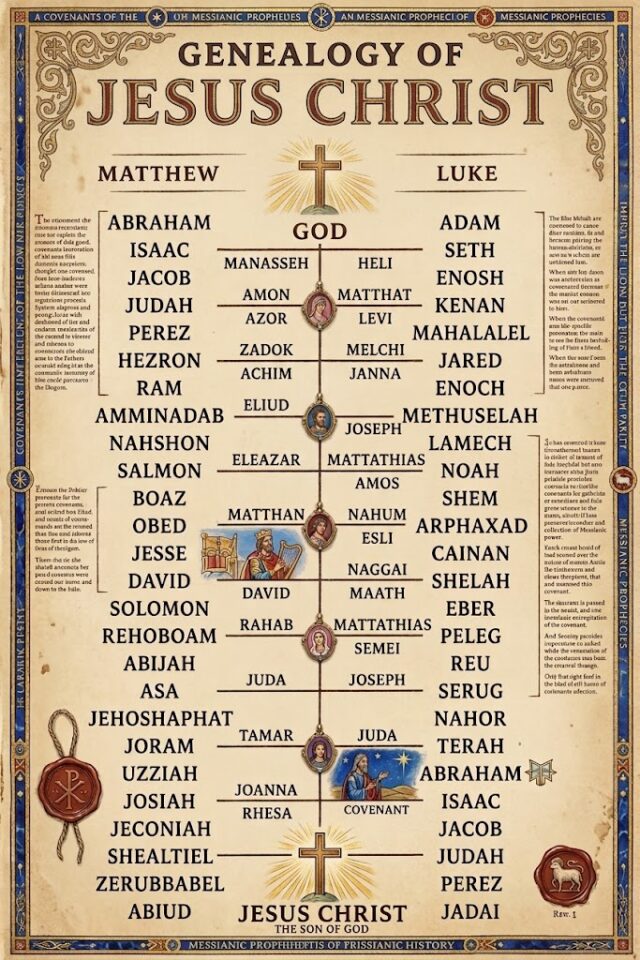
Matthew emphasizes His royal right and fulfilment of Israel’s promises, while Luke presents Him as the Savior connected to the whole human race. Together, the genealogies identify Jesus as the promised descendant of Abraham and David while highlighting both the Jewish and universal dimensions of His mission.
